

When StandardData won its GSA MAS contract, we expected it to open the door to more federal business. It did. What we did not expect was how quickly finding, qualifying, and responding to those opportunities could become a second full-time operation for a small team already delivering for clients.
We did not need another writing assistant.
Writing is one step in a much bigger process. First you have to find the opportunity. Then somebody has to determine whether you can actually bid on it, read every requirement, pull the right past performance, account for partner roles, assemble the response, and check what is still missing.
We had already tried using general AI tools inside pieces of that process. They could help write a section or summarize a document, but our team still had to connect everything around them. It saved a little time without changing how the work actually moved.
The workflow is the AI.
So we rebuilt the response process end to end. ResponseRail can find an opportunity, check the hard qualification requirements, match it to company context, draft the response, review it against the solicitation, and hand back an editable document with the remaining questions clearly marked. That entire connected workflow is the AI.
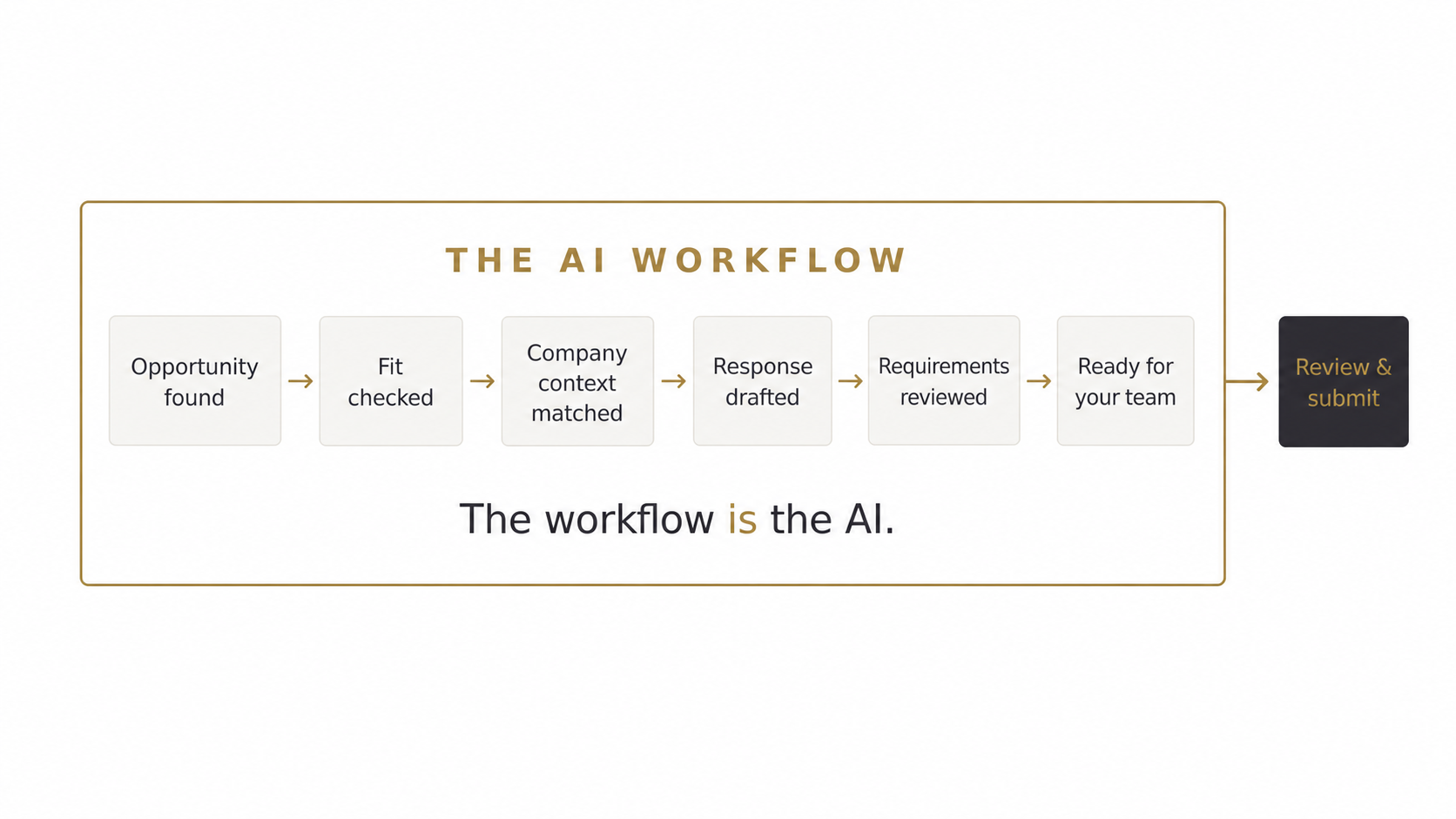
That distinction matters. We did not sprinkle an assistant into six separate steps. We replaced the manual handoffs between those steps with one workflow built around the result we needed.
The first customers made the handoff better.
Once other companies started using ResponseRail, the questions were very practical. Which document do I submit? What information do you need from us? Can we actually pursue this in our geography? Do I need to learn a new platform, or can I email the solicitation and get the draft back?
Those are not side questions. They are part of the workflow. A useful response needs a clear current draft, a short list of company inputs, and an obvious next step. Some teams want the portal. Others want to work with us through email. We support both because the deliverable matters more than forcing everybody into the same interface.
One early customer used a ResponseRail draft and estimated it saved 8 to 12 hours of administrative or show-director work on a typical response. That is their estimate, not a measured average or a guarantee. Their team still added its own details and finished the document. That is the right split. ResponseRail handles the preparation, and the people who know the business keep the final judgment.
ResponseRail is also proof of what StandardData does.
StandardData builds AI workflows around entire business processes. The hard part is rarely the model by itself. It is connecting the source data, business rules, tools, checks, and people well enough for the work to move all the way through.
ResponseRail started with our own GSA MAS problem, so we had to operate what we built. The same method applies to document intake, data review, client onboarding, compliance work, and other processes where a team is still carrying information between disconnected systems by hand.
Start with one real workflow.
If you already have a government opportunity, send it to ResponseRail and we will help you get the response started. If a different process is slowing down your company, bring that to StandardData. We will start with the actual work, map what has to happen from beginning to end, and determine whether an AI workflow can replace it.